
Fashion & Trends
No More Stolen Sisters: Why Maricopa Must Stand in Red — and Turquoise
By Maricopa Lifestyle Magazine · July 8, 2026
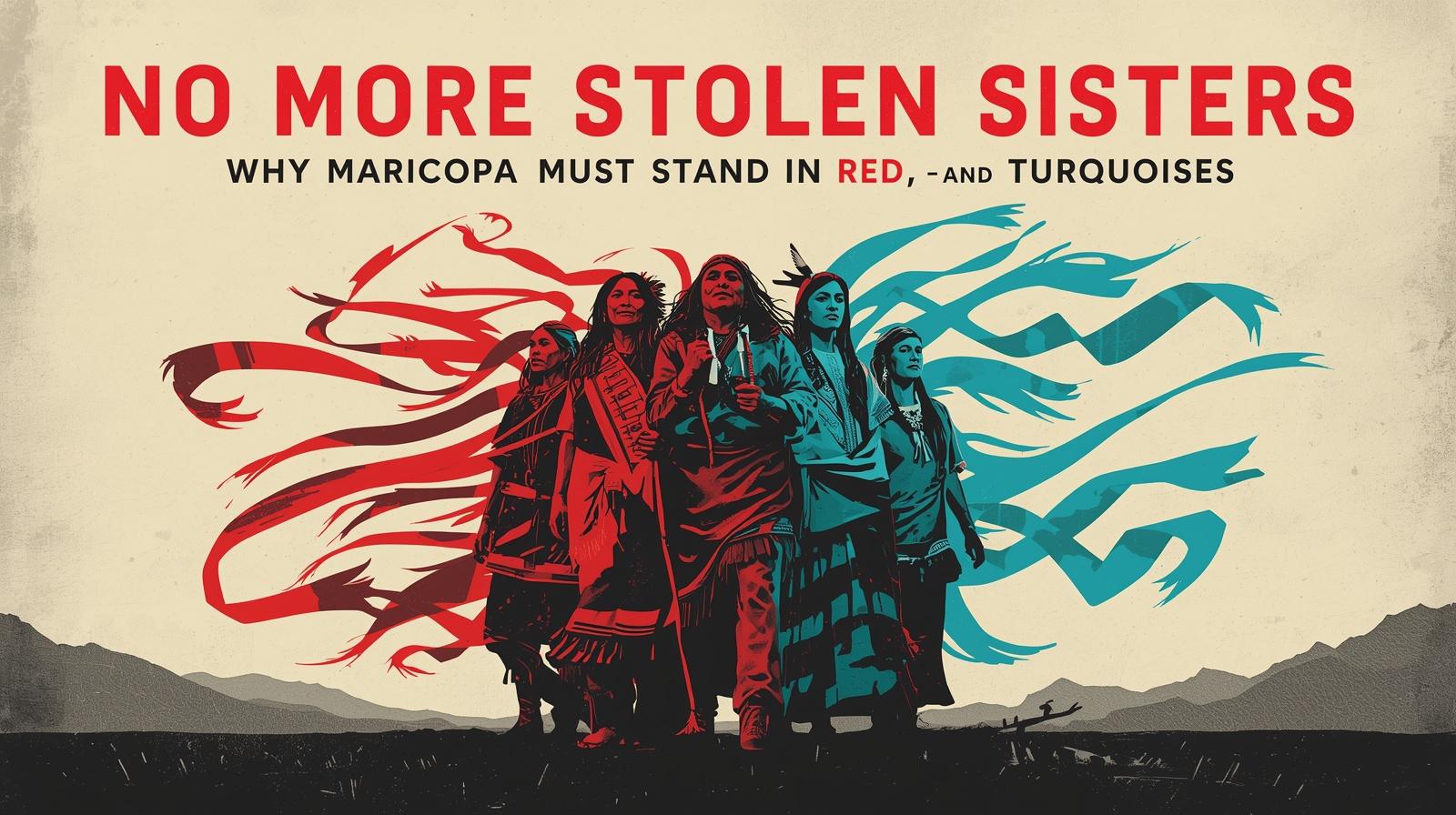
A call to awareness, action, and celebration of Indigenous life By Maricopa Lifestyle Magazine
By Maricopa Lifestyle Magazine
Today — May 5, 2026 — is not an ordinary Tuesday. Across the country and right here in the heart of Arizona, communities are wearing red. Empty red dresses hang from trees, windows, and fences. Vigils are being held. Names are being spoken aloud that too often go unheard. Today is Red Dress Day — the National Day of Awareness for Missing and Murdered Indigenous Women, Girls, and Relatives (MMIW/R) — and it matters profoundly to every resident of Maricopa.
(AI Generated Picture)
What Is Red Dress Day?
Red Dress Day is observed annually on May 5th, chosen to honor Hanna Harris, a Native American woman who was murdered in Montana in 2013. May 5th would have been Hanna's birthday, and the day was first recognized in the United States in 2017 as the National Day of Awareness for Missing and Murdered Native American Women. (Wikipedia)
-
The movement began with the REDress Project, created by Métis artist Jaime Black in 2010. On this day, red dresses are draped in trees, hanging from windows, pinned to jackets, worn as earrings, and red hands are painted across faces. People participate in rallies and ceremonies to honor their loved ones and fight for justice.
-
(Amnesty International Canada)
The color red was chosen with deep intention. Red symbolizes "our lifeblood and that connection between all of us." It is also a calling back of the spirits of these women — allowing them a chance to be among us and have their voices heard through their family members and community. (MLT Aikins)
-
The empty dresses are not decorations. They are absences. Each one represents a mother, daughter, sister, or friend — stolen.
-
The Crisis Is Real — and It Is Here
This is not a distant issue. Arizona is one of the ten states with the highest rates of American Indian and Alaska Native missing persons cases. On some reservations, Native women are murdered at ten times the national average. Homicide is roughly the third leading cause of death among Indigenous women ages 10 to 24. The FBI reported more than 10,248 missing Indigenous persons reports in 2024 alone — 5,614 of whom were women. (NIWRC)
-
Arizona is reported to have the third-largest number of missing and murdered Indigenous women and girls in the country, with 54 known cases in the Phoenix and Tucson metro areas alone. (Arizona Mirror)
These are not statistics. These are our neighbors.
-
The Laws Behind the Movement
Red Dress Day — Federal Recognition
In 2017, Senators Steve Daines and Jon Tester from Montana introduced a resolution recognizing May 5 as a National Day of Awareness for Missing and Murdered Native Women and Girls — directly in response to the murder of Hanna Harris on the Northern Cheyenne Reservation and other abductions and killings of Native women across the United States. (NIWRC)
-
Most recently, in May 2026, Representative Dan Newhouse and Representative Teresa Leger Fernández introduced a resolution to formally designate May 5, 2026, as a National Day of Awareness for Missing and Murdered Indigenous Women and Girls, reaffirming the federal commitment to this crisis. (Congressman Dan Newhouse)
Savanna's Act
-
Savanna's Act is named in honor of Savanna LaFontaine-Greywind, a 22-year-old pregnant citizen of the Spirit Lake Nation in North Dakota who was viciously murdered in August 2017. The Act, signed into law on October 10, 2020, aims to improve MMIW data collection and directs the Department of Justice to review, revise, and develop law enforcement and justice protocols to address missing and murdered Indigenous peoples. (NIWRC)
-
The Not Invisible Act
Also signed into law in October 2020, the Not Invisible Act was the first federal bill introduced by four enrolled members of federally recognized tribes. It establishes an advisory panel composed of law enforcement, tribal leaders, service providers, and survivors focused on violent crime against Indigenous women — making the federal government step up its coordinated response. (The Hill)
-
Arizona's Turquoise Alert System
Right here at home, Arizona took historic action. Governor Katie Hobbs officially signed House Bill 2281 — the Turquoise Alert System bill — into law on May 13, 2025, establishing a new system to issue statewide alerts for missing Indigenous or endangered persons using the federally authorized Emergency Alert System. (Wassaja Center)
The bill, sponsored by Representative Teresa Martinez of Casa Grande — who represents District 16, which includes the Gila River Indian Community and the Ak-Chin Indian Community — passed through both the House and Senate unanimously. The system was also amended to include minors who go missing, in response to high-profile cases like that of Emily Pike, an Indigenous teen whose disappearance and murder were cited by lawmakers as the driving force behind the measure. (Arizona Mirror)
-
Turquoise — a stone sacred to many Indigenous cultures of the Southwest — was deliberately chosen as the color of this alert system, honoring the communities it was built to protect.
-
Where People Are Gathering Today
Communities across the country are marking Red Dress Day with vigils, walks, art installations, and ceremonies. Here in Arizona and nationally, here is where you can show up:
-
Arizona — Gather Here
Heard Museum | 2301 N. Central Ave., Phoenix, AZ 85004 | Arizona's premier Indigenous cultural institution hosts year-round programming and awareness events. (602) 252-8840)
-
Gila River Indian Community | Sacaton, AZ | Home to tribal leadership active in MMIP advocacy and community support
-
Ak-Chin Indian Community | Maricopa, AZ | Right in our backyard — community-led awareness efforts and family support
-
Salt River Pima-Maricopa Indian Community | 10005 E. Osborn Rd., Scottsdale, AZ 85256 | Tribal programming and MMIP resources
-
Navajo Nation offices | Window Rock, AZ | Largest land-based tribal nation in the US, deeply engaged in MMIP advocacy
-
ASU Wassaja Center | Arizona State University, Tempe, AZ | Research, resources, and support for Indigenous students and families impacted by MMIP
-
National Organizations — Get Connected
National Indigenous Women's Resource Center (NIWRC) | niwrc.org |
-
The national leader in advocacy, toolkits, and family resources
Urban Indian Health Institute | uihi.org | Research and resources for urban Indigenous communities
-
REDress Project | The original art installation that started it all
If You or Someone You Know Needs Help
No family should face this alone. These resources exist right now:
Resource Contact
National Crisis Line
988 (press 1 for Native Americans)
-
StrongHearts Native Helpline (DV/SA)
1-844-762-8483
NIWRC Family Toolkit
niwrc.org/mmiwr-awareness
-
NamUs Missing Persons Database
-
Turquoise Alert (AZ)
Report to local law enforcement to activate
Gila River Police Department
(520) 562-2530
Arizona DPS
(602) 223-2000
-
If someone is missing, report immediately. Do not wait. The first 72 hours matter most.
-
Something Beautiful Is Coming — Maricopa Fashion Week 2027
Awareness is only the beginning. Art is how communities heal — and Maricopa Lifestyle Magazine believes that the most powerful response to pain is the celebration of beauty, resilience, and cultural pride.
-
That is why we are proud to announce:
🪶 MARICOPA FASHION WEEK — MAY 2027
"Woven in Strength: A Celebration of Indigenous Design"
Presented by Maricopa Lifestyle Magazine
Benefiting the Turquoise Indigenous Foundation & MMIW/R Awareness
-
Next May, in honor of Red Dress Day and the Turquoise Alert System, Maricopa Lifestyle Magazine will launch the first-ever Maricopa Fashion Week — a multi-day celebration of Indigenous fashion, design, and artistry, featuring:
-
🧵 Designs created exclusively by Maricopa Indigenous Artisans — wearable art rooted in culture and crafted by local hands
🎓 Modeled by Maricopa High School and College Students — the next generation stepping into their power on the runway
🪶 A runway show honoring Indigenous textile traditions — beadwork, weaving, regalia-inspired fashion, and contemporary Indigenous design
💛 A community market featuring Indigenous-owned businesses, artists, and makers
❤️ A red dress installation — displayed in honor of MMIW/R throughout the event
🎤 Speaker series featuring Indigenous voices on art, identity, and community safety
Proceeds to benefit:
The Turquoise Indigenous Foundation — supporting the Turquoise Alert System and MMIP family resources in Arizona
MMIW/R Awareness programming throughout Maricopa County
A Final Word
Wearing red today is an act of love. It says: I see you. I remember you. I will not let your name be forgotten.
-
But awareness without action is just a moment. Maricopa is a growing city — 80,000 residents strong — and the Indigenous communities who have called this land home for thousands of years deserve to see that growth reflect their safety, their dignity, and their culture.
-
Wear red today. Learn the laws. Support the families. Show up in May 2027.
-
Because fashion can be resistance. Art can be justice. And community — real community — never leaves anyone behind.
-
For more information, to nominate an Indigenous artisan for Maricopa Fashion Week 2027, or to support the Turquoise Indigenous Foundation, contact Maricopa Lifestyle Magazine.
#RedDressDay #NoMoreStolenSisters #TurquoiseAlert #MaricopaFashionWeek #MMIWR #MaricopaLifestyleMagazine
-